
Manage your catalogue, audit your income.
In a publishing company income never leaks from just one place: an underpaid distribution share, a publisher share that never arrives from abroad, a missed contract renewal, a video nobody ever claimed. MEDUSA Rights watches all of these in one system — comparison done by hand, line by line, becomes a single file upload; findings turn into claimable records; advance decisions rest on past data rather than instinct.
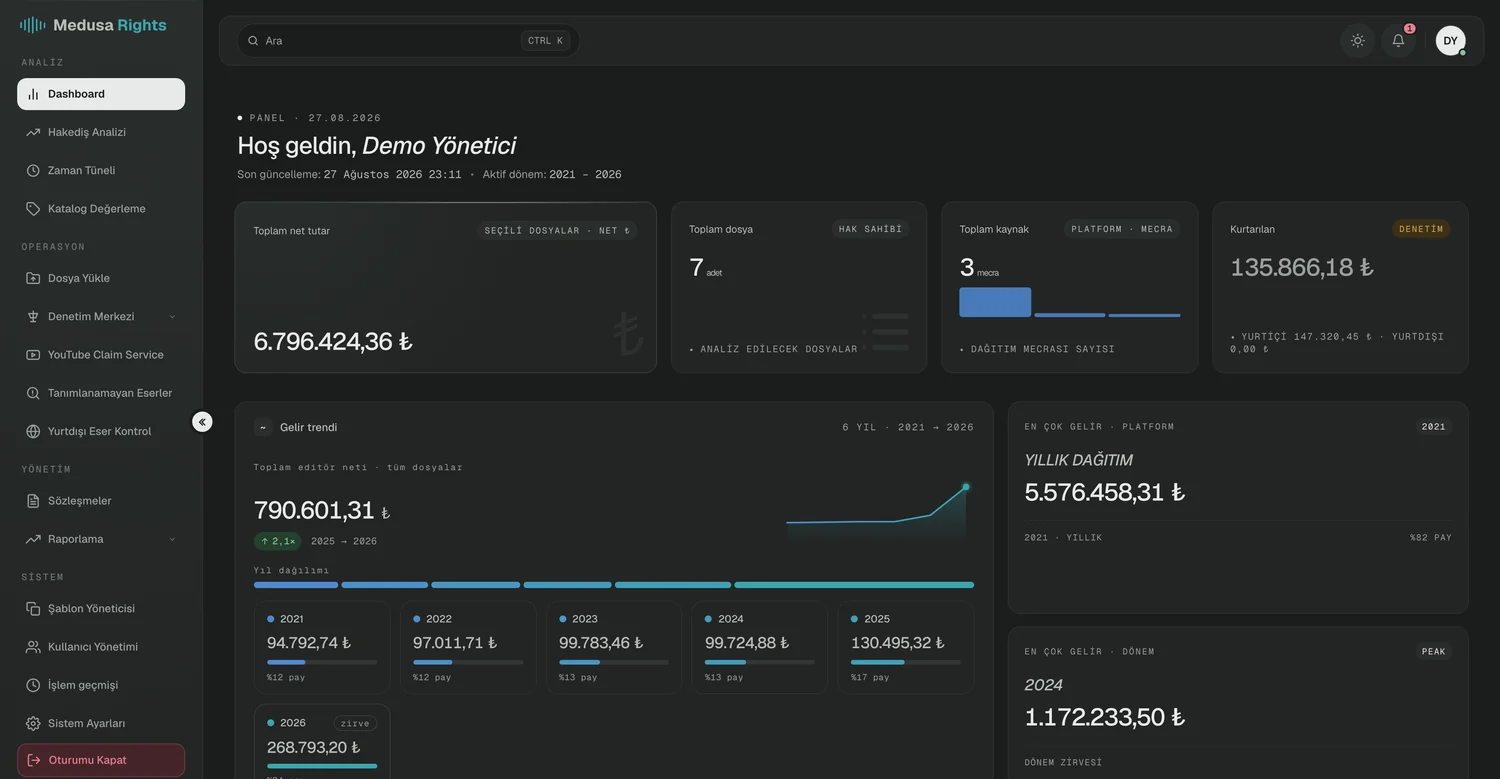
Dashboard — from a demo environment prepared with sample data. Click to enlarge.
It tells you where you stand.
The first screen you see is not a report but a status summary: income across periods, the amount recovered through audits, the domestic and international split, the highest-earning period. Click a year and the periods inside it open up.
Its real job is to direct you. If a number differs from what you expected, you move from here into the module it came from — the dashboard does not give you the answer, it shows you where the answer lives.
Every line ends in one of four verdicts.
A distribution statement can carry thousands of lines; telling which ones were paid correctly is not something the eye can do. MEDUSA Rights calculates the expected publisher share for every line from the contract rate and compares it against what was paid. The result is not an estimate but one of four definite states — and each opens down to its source in a single click.
- Matched — expected and paid amounts agree
- Underpaid — the gap is listed as a claimable amount
- Overpaid — deviations in your favour are shown too, so a later offset is no surprise
- Unmatched — with the reason: no contract, or no counterpart in the publisher file
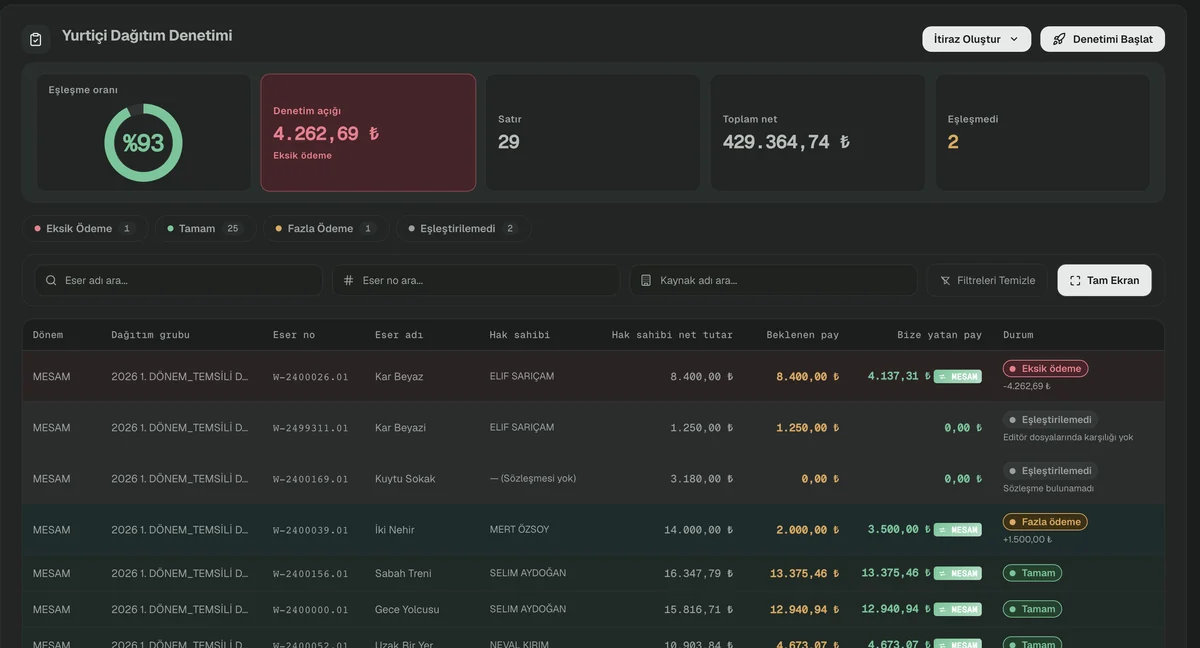
From a demo environment prepared with sample data. Click to enlarge.
The writer got paid. Did you?
In international distributions the quietest loss is a publisher share that never appears. The writer side is paid regularly while the publisher side stays empty for years, and this is invisible from a single period statement. MEDUSA Rights matches both sides work by work, stacks every period on top of one another, and separates out the works whose share never arrived.
- Matching logic that resolves the name-order trap in works with several writers
- A claim record for every candidate, tracked from opening to resolution
- Recovered in a later period, or recurred — tracked across periods
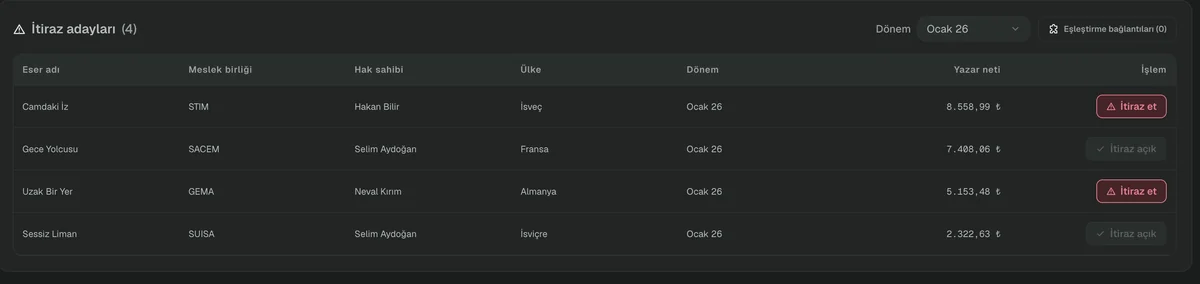
From a demo environment prepared with sample data. Click to enlarge.
Missing income shows up before the audit does.
An income line quietly disappearing is usually the first sign of under-reporting. MEDUSA Rights tracks your portfolio year by year, broken down by artist and category, and flags drops, disappearances and statistical outliers as separate signals. For the coming period it gives no single figure — it gives a band with lower and upper bounds, and the confidence level of that band.
- Comparison always runs within the same category, year over year
- If data is insufficient no forecast is produced, and a “high confidence” label is never given
- You can drill from artist level down to individual works
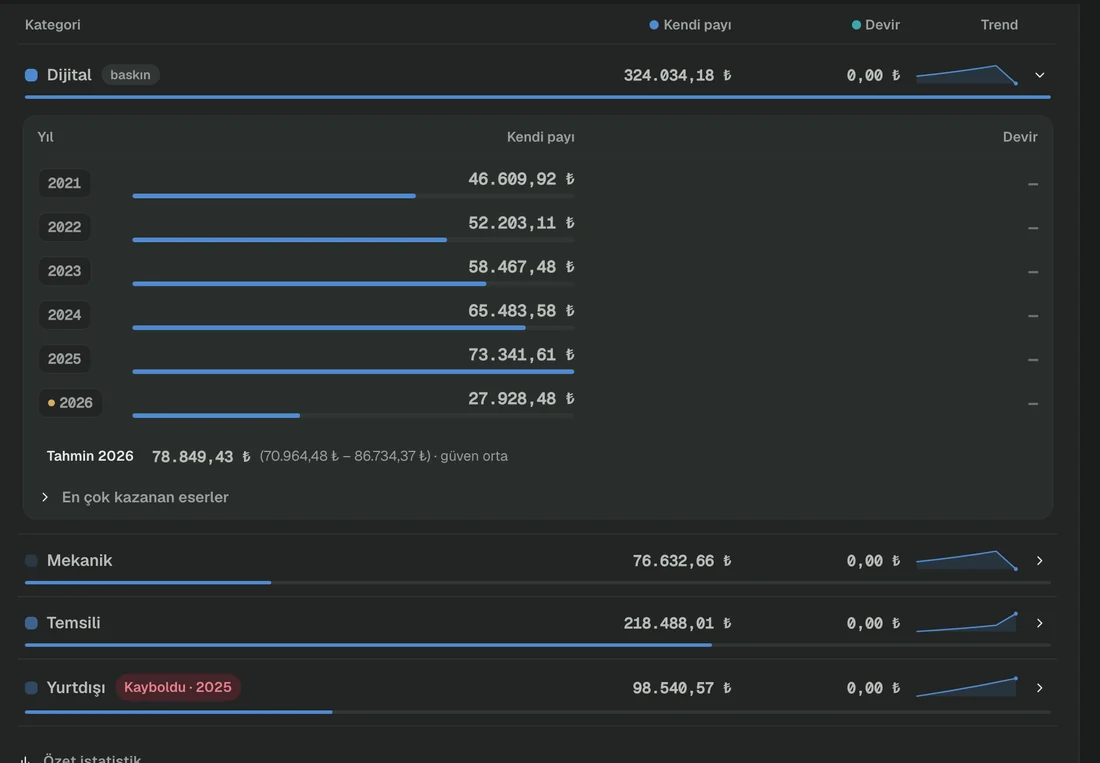
From a demo environment prepared with sample data. Click to enlarge.
An advance is not decided by instinct.
Preparing an offer for a new catalogue always raises the same question: at what share rate, in how many years does this advance pay back? MEDUSA Rights reads the prospective artist’s royalty history, extracts the income trend, and produces a scenario table over a fifteen-year projection. If exchange-rate data is missing it does not quietly fill the gap with an assumption — it stops and names what is absent.
- Two debt models: currency-indexed and local-currency fixed
- Share-rate scan: a separate payback period for every rate
- Runs independently of your existing contracts and never touches your catalogue
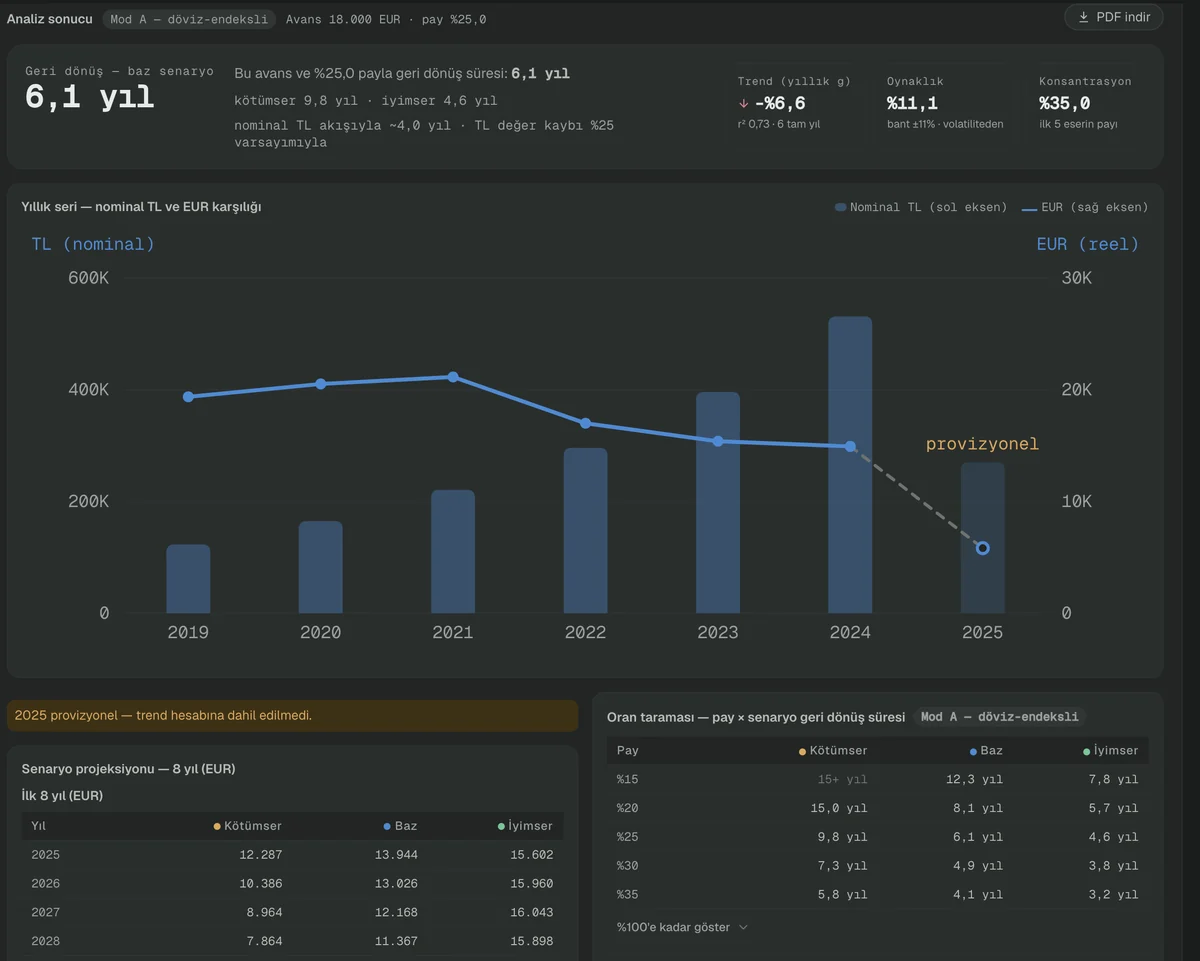
From a demo environment prepared with sample data. Click to enlarge.
Which rate applied back then? The system remembers.
A contract changes over the years: the term extends, an addendum is signed, the rate is revised, sometimes a termination arrives. Auditing a distribution from three years ago, you never have to remember which rate was in force then — MEDUSA Rights keeps the contract’s entire history with its dates and feeds the audit engine from there.
- The period chain: first term, addendum, automatic renewal and termination on one timeline
- Dated rate versions — which rate applied in which period is on record
- Contract documents, work list and stakeholder details on the same card
- A warning 180 days before a period ends, which stops once you mark it handled
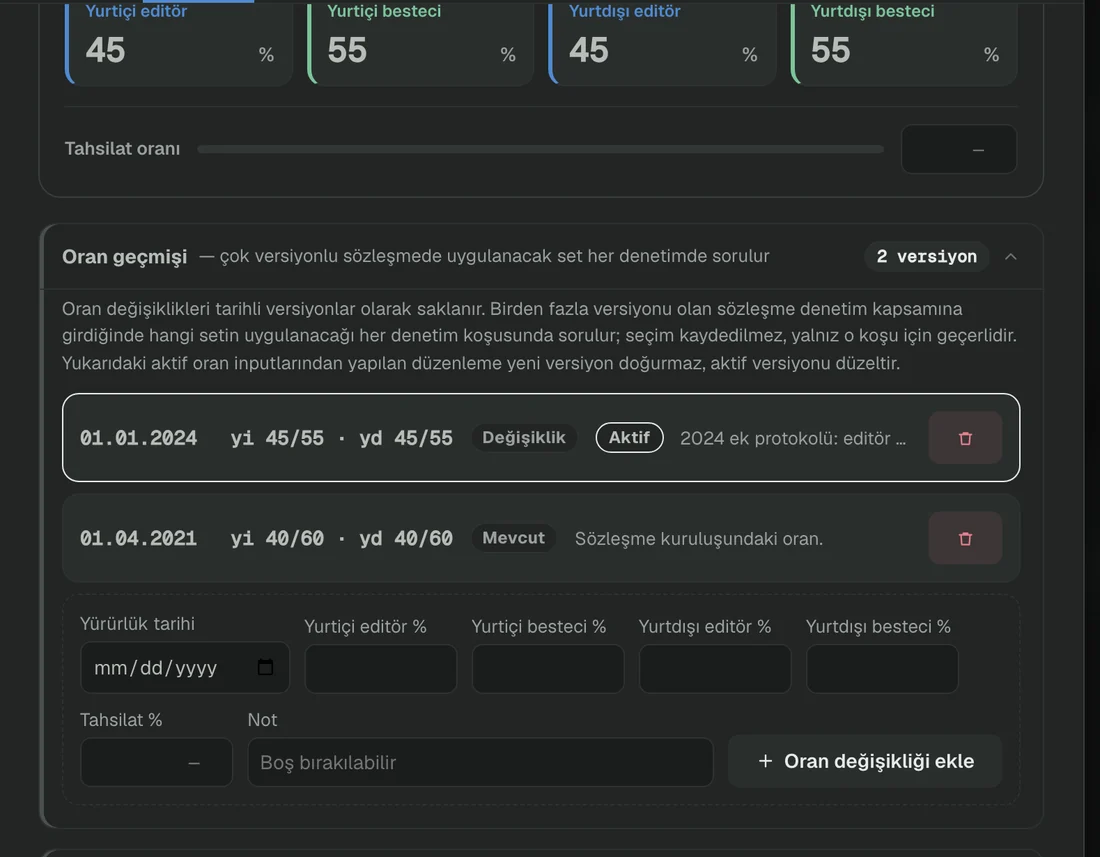
From a demo environment prepared with sample data. Click to enlarge.
Know which video you missed.
On digital platforms income is most often lost not through the work itself but through an upload nobody noticed. MEDUSA Rights takes your work list, scans for videos that may belong to those works, and presents every result with a confidence level. What you end up with is not a list to search but a table to work through: export it to Excel and carry out the check on the society’s side under your own authority.
- Matching is built from the title, the channel name and the credits in the description
- Videos with a weak signal but high view counts are flagged separately — the case most easily missed
- You mark the ones you have handled, and they do not return on the next scan
- No automatic connection to any external system; no action is taken on your behalf
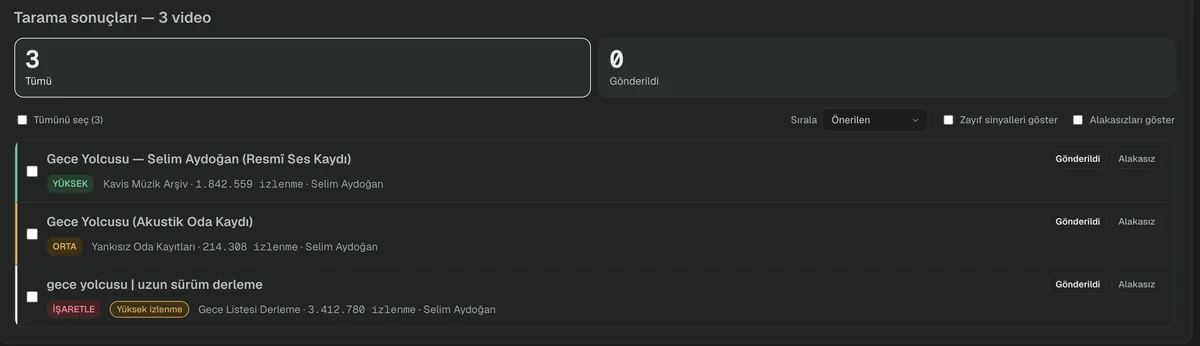
From a demo environment prepared with sample data. Click to enlarge.
An incoming request becomes a process you can follow.
When a production company wants to use a work from your catalogue in a series or a commercial, it begins as a piece of correspondence — and often stays there. MEDUSA Rights turns that request into a numbered record: rights holder approval, offer, licence, invoice and collection, every step recorded and every transition governed by a rule.
- The quote stage cannot be reached until every rights holder has approved
- On a foreign-currency offer that day’s rate is stamped; later movement does not change the calculation
- On collection the rights holder share is calculated from the contract rate and frozen
- A warning arrives 90 days before the licence ends
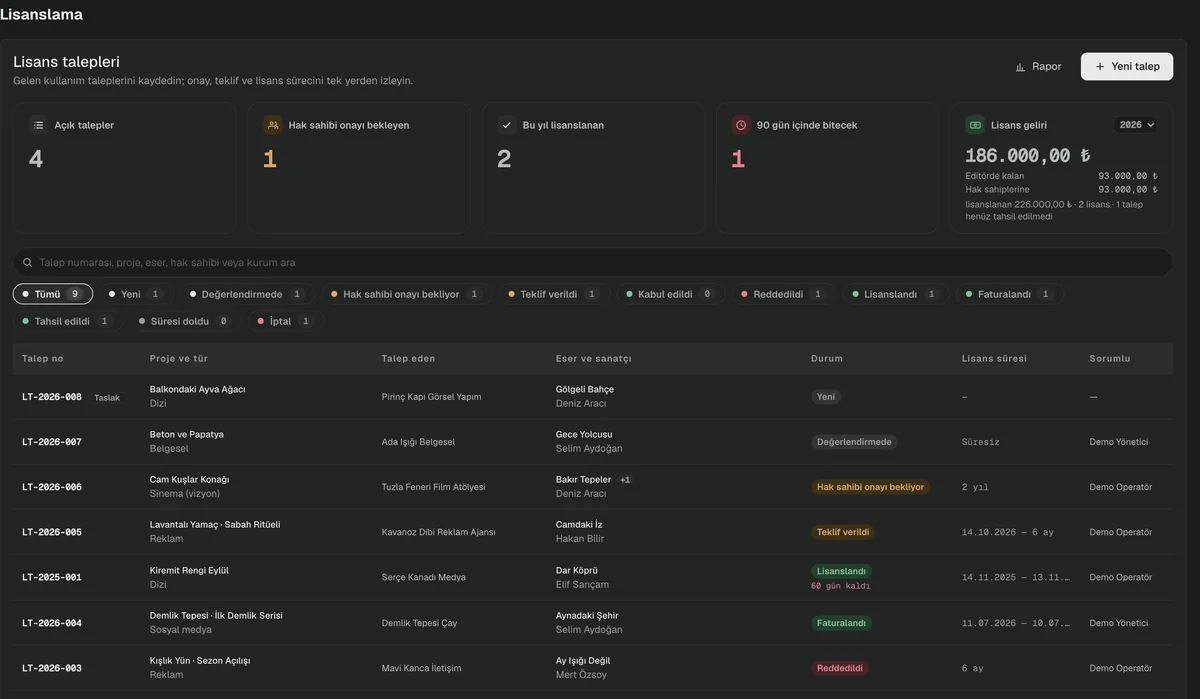
From a demo environment prepared with sample data. Click to enlarge.
What changes in a publishing company?
The same work is already being done. What changes is how much of it can be done, and how much of it stays on record.
Eleven modules, one system.
Every module has its own page: the problem it solves, how it works, its screens — and what it does not do.
International distribution audit
Finds works where the writer share was paid but the publisher share never appeared, by comparing every period.
Read more →Domestic distribution audit
Calculates the expected publisher share from the contract rate; every line ends in one of four definite verdicts.
Read more →Royalty analysis
Tracks income lines year by year and flags a falling or vanished line as a sign of under-reporting.
Read more →Catalogue valuation
Builds a fifteen-year projection and a scenario table from a prospective catalogue’s royalty history.
Read more →Contract management
Periods, addenda, terminations and dated rate versions on one card — this is what feeds the audit engine.
Read more →Sync licensing
Turns a sync request into a numbered record and tracks it through an eleven-state process from approval to collection.
Read more →YouTube claim check
Lists videos that may belong to your works with a confidence level, and exports to Excel.
Read more →International work registration check
Scans in bulk whose name your works are registered under in foreign registries.
Read more →Unidentified works
Compares a society’s unidentified pool against your catalogue and scores the suggestions.
Read more →Reporting
Raw distribution data becomes a dataset you can filter and search by period, work and platform.
Read more →Access control and audit log
Role-based access, a separate permission for financial data, and a permanent record of every action.
Read more →Which society does this file belong to, and which side — rights holder or publisher?
Which contract period does this distribution fall into? Your answer is remembered.
The contract has more than one rate version. Which one applies to this audit?
It does not guess. It asks, then calculates.
A wrong audit report costs more than no audit at all. That is why every point left uncertain is put to you before the calculation begins.
Upload
Leave the Excel file exactly as the society sent it. It is read line by line and matched against your catalogue; try to upload the same file twice and the system warns you.
Verify
Three gates open in sequence. No calculation runs until side, period and rate version are settled; your answers are stored for later audits.
Audit
The expected publisher share is calculated from the contract rate and compared to the amount paid. The result is one of four states; no line is ever marked “probably”.
Let us run it on your own catalogue.
In a half-hour call we can show MEDUSA Rights live and, if you like, run it on a sample of your own distribution statement.
- No installation — it runs in the browser
- Any data used in the call is deleted afterwards
- We reply within two business days