
Home › Modules › Unidentified works
MATCHINGIs one of your works sitting in the unidentified pool?
It compares a collecting society’s pool of works with no identified owner against your catalogue and presents scored similarity suggestions — the decision stays with you.
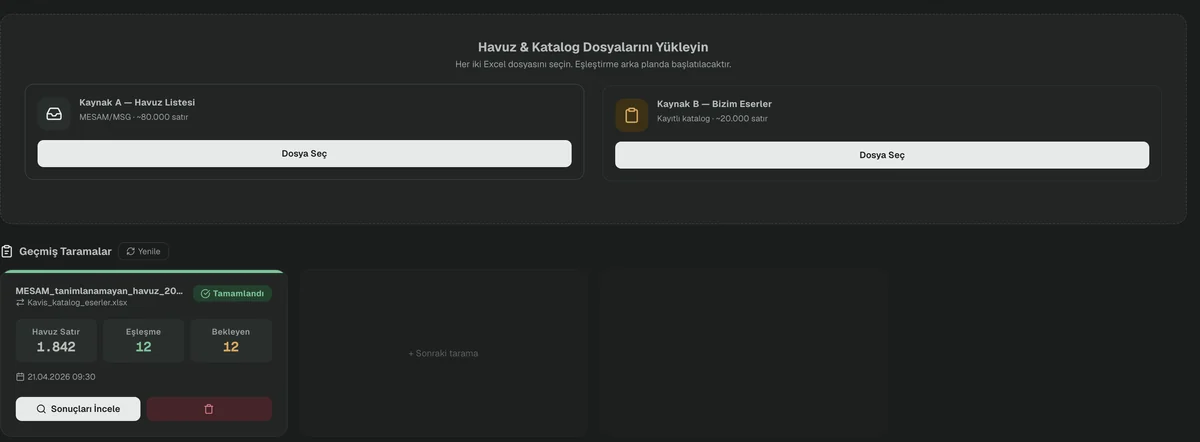
From a demo environment prepared with sample data. Click to enlarge.
The problem it solves
Collecting societies keep works whose rights holder could not be matched in a separate pool. That pool can run to tens of thousands of lines, and your works may well be inside it: spelled with one letter different, missing a co-writer, or never registered at all.
Scanning the pool by hand is not practical. But leaving the matching entirely to a machine is not right either — a wrong match means claiming a right that is not yours.
How it works
Upload both files
The society’s pool list and your own catalogue file are provided together.
Let the matching run
Similarity is computed on work title and performer; the threshold is raised for single-word titles and weak matches are discarded.
Review the suggestions
Each candidate is listed with its similarity score and the reason for the match: performer consistent, different, or absent. If a pool line produces more than one candidate, all of them are shown. You can filter by score.
Make the decision
What you approve goes into the output; what you reject does not come back. You send the result file to the society yourself.
Matching results
Each row places the pool work on the left and the suggested catalogue work on the right; the score ring between them shows similarity, the badge underneath shows performer consistency. You can accept or reject rows one by one or in bulk.
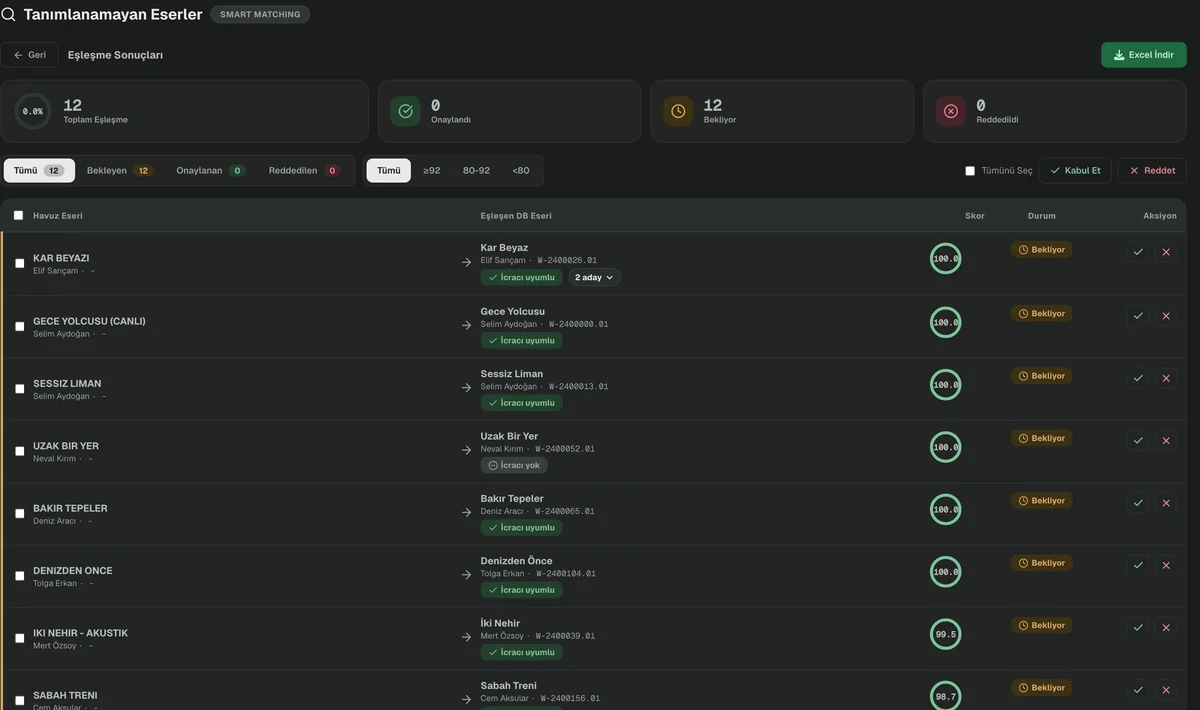
From a demo environment prepared with sample data. Click to enlarge.
Input and output
WHAT YOU PROVIDE
- The society’s pool of unidentified works (Excel)
- Your own catalogue file (Excel)
WHAT YOU GET
- Scored similarity suggestions
- Performer consistency indicator
- A record of your accept and reject decisions
- Excel export and a result file for the society
What it does not do
Knowing the limits of a tool matters as much as knowing its capabilities.
- It never approves a match on its own. It produces suggestions; the user decides.
- It does not notify the collecting society automatically.
- Pool file formats differ between societies; an unrecognised format has to be templated first.
See unidentified works on a live system.
In a half-hour call we can run it on your own catalogue.