
Home › Modules › Catalogue valuation
DECISION SUPPORTAn advance is not decided by instinct.
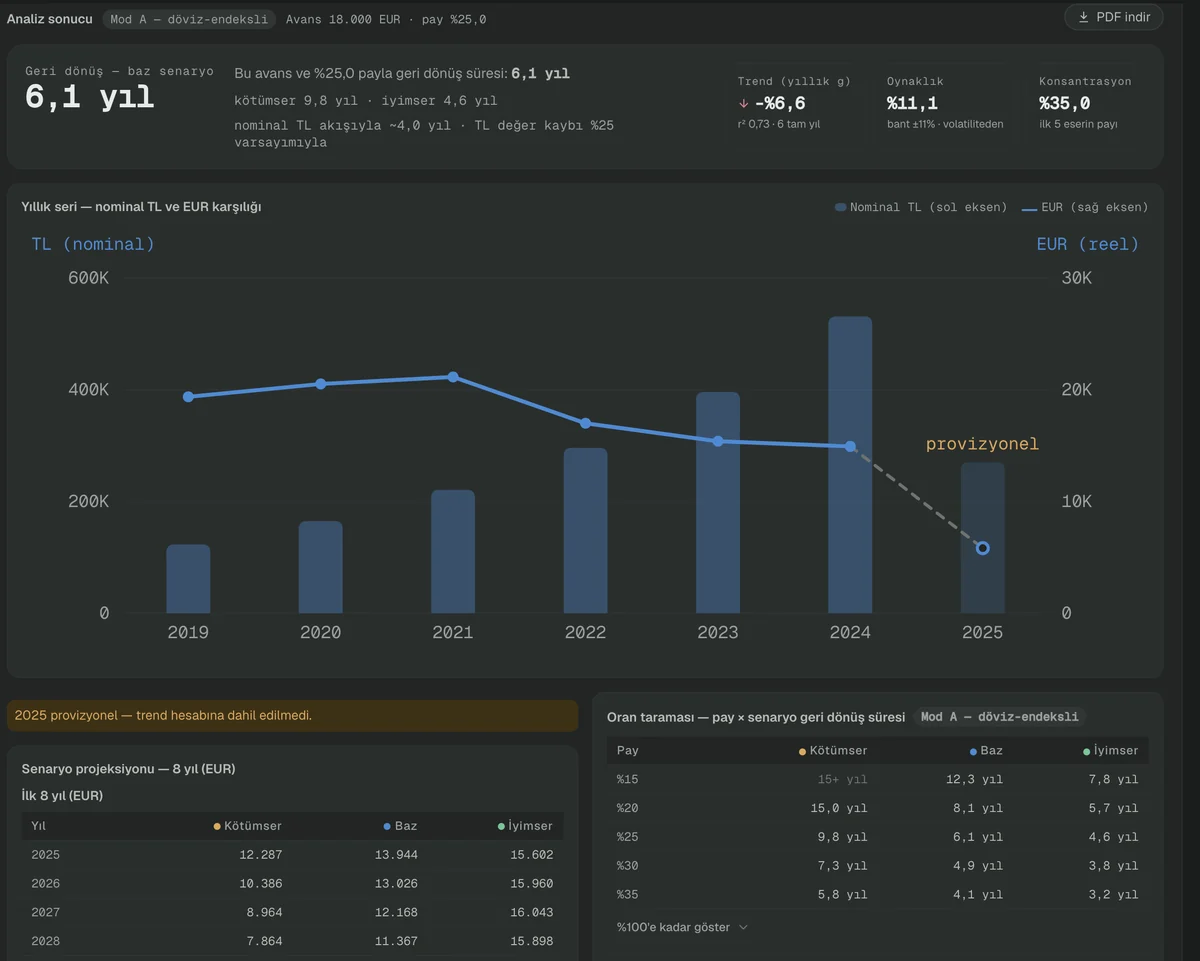
It builds a fifteen-year projection from a prospective artist’s royalty history and compares advance, share rate and payback period in a scenario table.
From a demo environment prepared with sample data. Click to enlarge.
The problem it solves
When preparing an offer for a new catalogue the question is always the same: at this share rate, in how many years does this advance pay back? The answer depends on three unknowns — the income trend, the currency path, and which currency the debt is tracked in.
Calculated by hand, these three usually produce a single optimistic scenario, and the decision rests on it. Yet the real information lies in the difference between scenarios.
How it works
Load the royalty history
Past distribution statements for the prospective artist are read; yearly totals and category distribution are extracted.
Choose the debt model
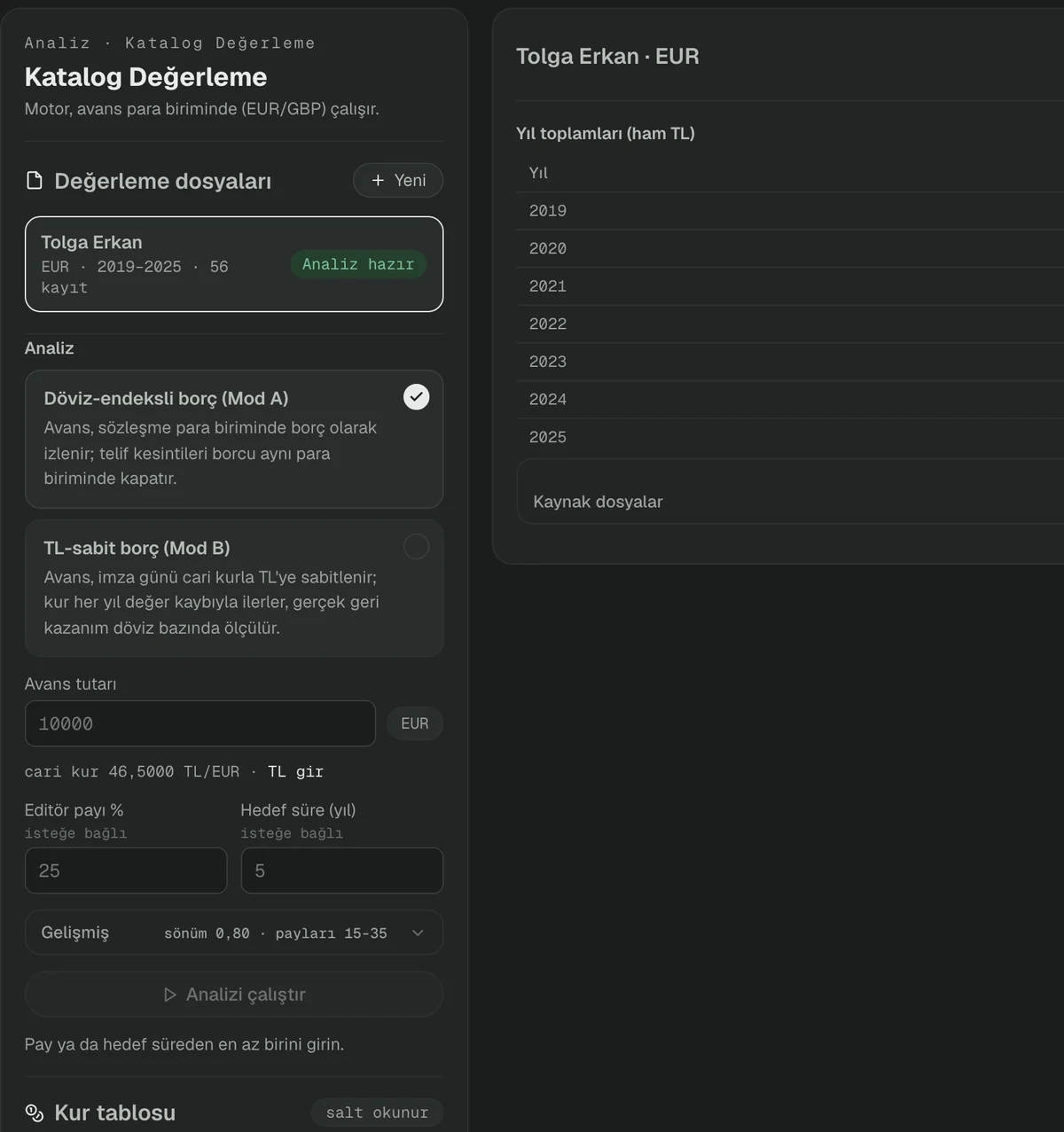
Currency-indexed or local-currency fixed. The choice determines who carries the exchange-rate movement, and it changes the outcome directly.
Run the analysis
A fifteen-year projection is produced in three scenarios: pessimistic, base, optimistic. If exchange-rate data is missing, the analysis does not fill the gap with an assumption — it stops and tells you what is missing.
Read the rate scan
A separate payback period is calculated for every share rate. Which rate, how many years — as a table, with its scenarios.
What goes in
The debt model, the advance amount and the currency are set before the analysis runs. The exchange-rate table is read-only — the engine will not proceed on assumed rates.
From a demo environment prepared with sample data. Click to enlarge.
Input and output
WHAT YOU PROVIDE
- Past royalty statements for the prospective artist
- Advance amount and currency
- Debt model selection
- Exchange-rate data
WHAT YOU GET
- Payback period in three scenarios
- Fifteen-year projection
- Share-rate scan
- Trend, volatility and catalogue concentration indicators
- Two-page PDF report
What it does not do
Knowing the limits of a tool matters as much as knowing its capabilities.
- It runs independently of your existing contracts; prospective data does not enter your catalogue.
- If exchange-rate data is missing it does not quietly assume — the analysis stops and names what is absent.
- It does not make a recommendation. The decision is yours; the system only puts the numbers in front of you.
See catalogue valuation on a live system.
In a half-hour call we can run it on your own catalogue.